

TARLAKENYO — Malacañang has officially released the list of regular holidays and special days for the year 2027, after President Ferdinand R. Marcos, Jr. signed Proclamation No. 1427 on September 8, 2026.
The proclamation, signed by Acting Executive Secretary Ralph Recto, sets the dates for the country’s regular holidays, special (non-working) days, and one special (working) day, providing Filipinos with a guide for planning vacations, family gatherings, and observances for the coming year.
Regular Holidays
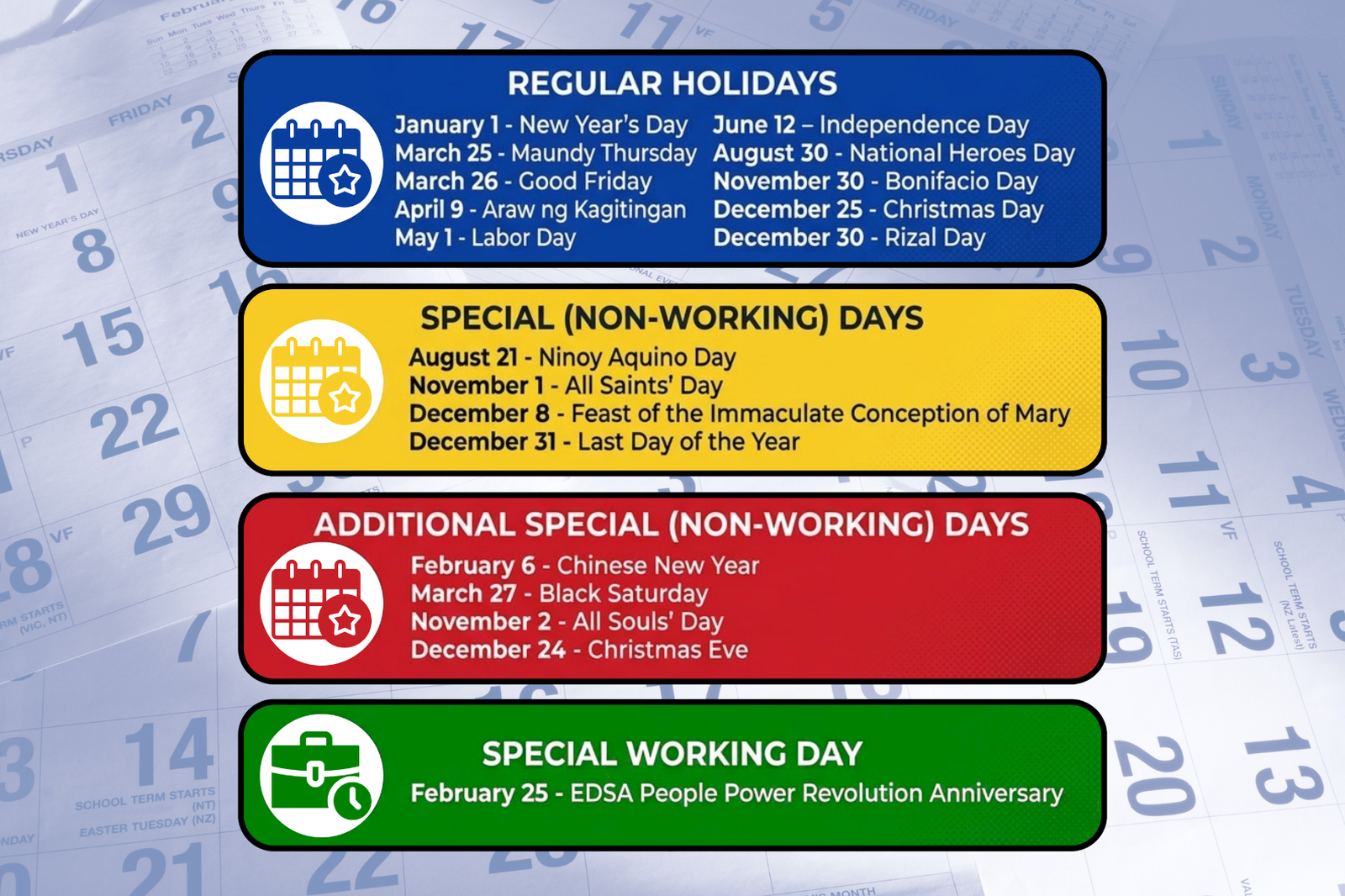
Under Section 1 of the proclamation, the following dates are declared regular holidays for 2027:
- New Year’s Day – January 1 (Friday)
- Maundy Thursday – March 25
- Good Friday – March 26
- Araw ng Kagitingan – April 9 (Friday)
- Labor Day – May 1 (Saturday)
- Independence Day – June 12 (Saturday)
- National Heroes Day – August 30 (Last Monday of August)
- Bonifacio Day – November 30 (Tuesday)
- Christmas Day – December 25 (Saturday)
- Rizal Day – December 30 (Thursday)
Special (Non-Working) Days
The following dates are declared special (non-working) days nationwide:
- Ninoy Aquino Day – August 21 (Saturday)
- All Saints’ Day – November 1 (Monday)
- Feast of the Immaculate Conception of Mary – December 8 (Wednesday)
- Last Day of the Year – December 31 (Friday)
Additional Special (Non-Working) Days
The proclamation also includes four additional special (non-working) days:
- Chinese New Year – February 6 (Saturday)
- Black Saturday – March 27
- All Souls’ Day – November 2 (Tuesday)
- Christmas Eve – December 24 (Friday)
Special (Working) Day
The EDSA People Power Revolution Anniversary on February 25 (Thursday) is declared a special (working) day. This marks the 41st anniversary of the 1986 revolution that ushered in political, social, and economic reforms in the country.
Eid’l Fitr and Eid’l Adha
In accordance with Section 2 of the proclamation, the dates for Eidul Fitr and Eidul Adha will be announced through separate proclamations after the approximate dates of the Islamic holidays have been determined in accordance with the Islamic calendar (Hijra) or the lunar calendar, or upon Islamic astronomical calculations.
The National Commission on Muslim Filipinos will recommend the actual dates to the Office of the President.
Rationale Behind the Declaration
The proclamation cited several laws and considerations for the holiday declarations, including Republic Act No. 9492, which amended the Administrative Code of 1987, and RA No. 9849, which provides for the observance of Eidul Adha.
The additional special non-working days on November 2 and December 24 were included to “strengthen family ties by providing more time for the traditional All Saints’ Day, All Souls’ Day, and Christmas Day activities as well as promote domestic tourism.”
The Department of Labor and Employment (DOLE) has been tasked to promulgate the implementing guidelines for the proclamation, which takes effect immediately and will be published in a newspaper of general circulation.
