

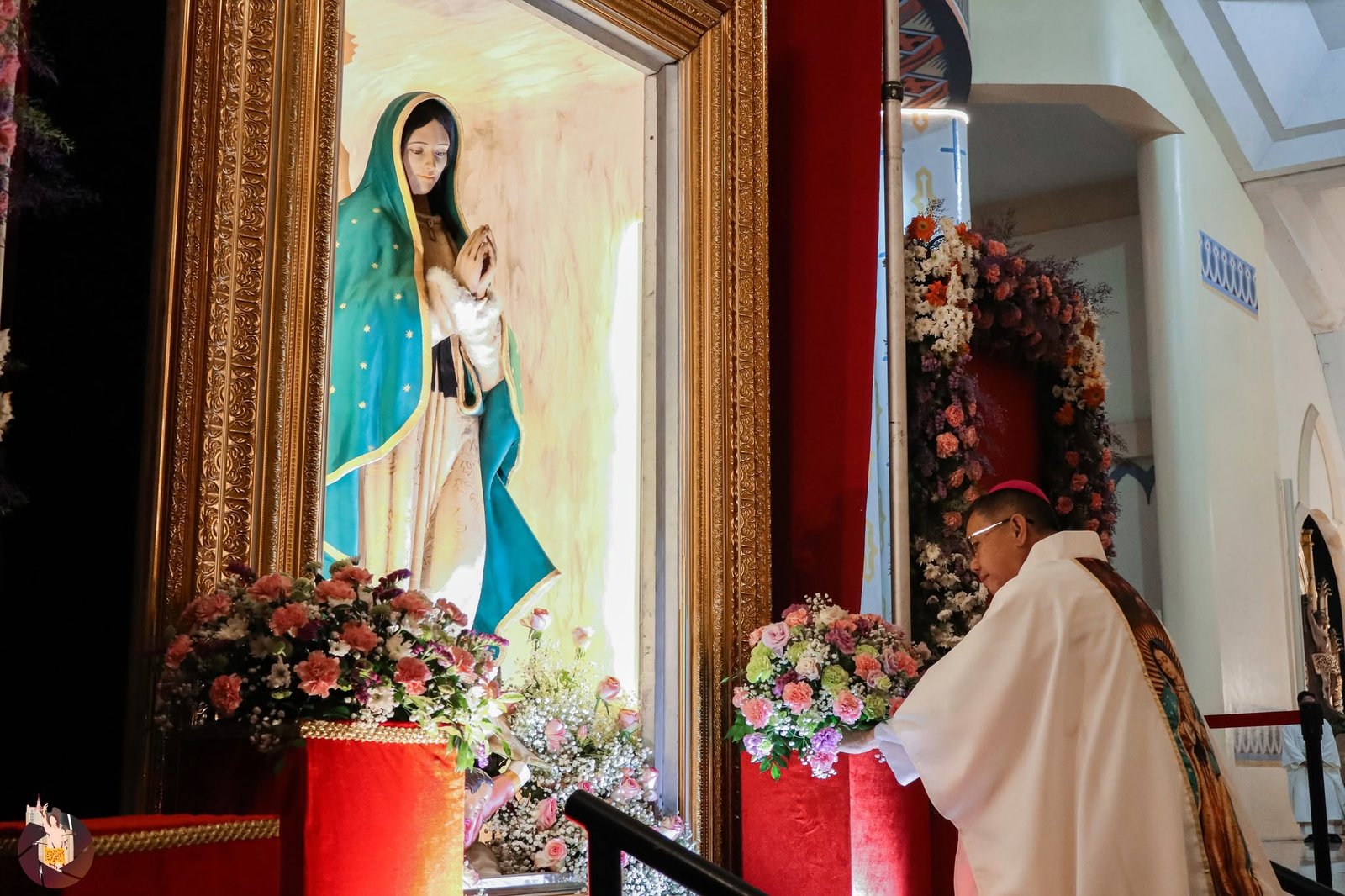
TARLAC CITY, Tarlac — Faithful from across the diocese gathered at the San Sebastian Cathedral from November 6 to 9 to welcome the International Pilgrim Image of Our Lady of Guadalupe, as the Diocese of Tarlac became the latest stop in the Marian icon’s six-month journey across the Philippines.
Bishop Roberto Mallari led the welcome procession and celebrated the Holy Mass, which was concelebrated by several priests, including the parish priests of the diocese’s two Our Lady of Guadalupe parishes in Malacampa, Camiling and Dapdap, Bamban.
There are three images that form part of the pilgrimage: a life-size, hyper-realistic 3D statue of the Virgin sculpted by Mexican artist Jorge Ismael Rodríguez; an official framed replica of the tilma — a digital reproduction blessed and touched to the original image at the Basilica in Mexico City, and thus considered a second-class relic; and a framed image of St. Juan Diego.
The pilgrim images arrived from the St. Joseph the Patriarch Cathedral Parish in Alaminos City, Pangasinan, and was met by students, youth groups, and devotees. The welcome rites featured colorful cultural dances and a band-led procession.
A Mother’s Message
In his homily, Bishop Mallari reflected on the maternal love at the heart of the Guadalupe apparitions, recalling the moment when St. Juan Diego, worried about his ailing uncle, tried to avoid meeting the Virgin.
“Then she spoke words that have become among the most beautiful expressions of her maternal love: ‘Am I not here? I who am your mother?’ What a beautiful question,” the bishop said.
He noted that the Church is journeying toward 2031, the 500th anniversary of the apparitions and the miraculous image left on St. Juan Diego’s tilma, and urged the faithful to go beyond merely marking the passage of time.
“The most important question is not how many places her image will visit—it is how many hearts will be touched by her message,” he said.
Bishop Mallari also reminded the faithful of the Philippines’ special bond with the Virgin of Guadalupe, recalling that Pope Pius XI proclaimed her the celestial patroness of the country in 1935.
The bishop encouraged those carrying burdens like illness, financial worries, uncertainty about the future to remember the Virgin’s words. “Her image may leave our church, but her maternal love should never leave our hearts,” he said.
Veneration and Farewell
Rev. Fr. Jason Aguilar, rector of San Sebastian Cathedral and vicar general of the diocese, thanked the bishop, the concelebrating priests, and the many volunteers and organizations including the Cathedral staff, religious ministries, Marian organizations, the Knights of Columbus of the Diocese of Tarlac, and the Tarlac National High School Rondalla and Drum and Lyre Corps who helped facilitate the visit.
Throughout the image’s stay, the faithful kept vigil with rosaries, flower offerings, and a Harana kay Maria, while confessions were made available and daily Masses offered at the cathedral. The visit concluded with a farewell Mass, after which the image departed the diocese for the next stop on its nationwide journey.
Background: A Nationwide Journey
The Philippine pilgrimage, part of the worldwide Novena Intercontinental Guadalupana preparing for the 2031 quincentenary, began in June with the reception and blessing of the image at Malacañang Palace.
It is set to bring the image to more than 50 cathedrals, shrines, and parishes before its permanent installation at the Manila Cathedral in December, culminating in a solemn procession on her feast, December 11–12. Cardinal Jose Advincula of Manila named the pilgrim image Madre Peregrina de Guadalupe — “Pilgrim Mother of Guadalupe.”
The Philippines, home to more than 93 million Catholics, is the largest Catholic nation in Asia. In 2002, the CBCP recognized Our Lady of Guadalupe as the “Pro-Life Patroness of the Philippines.”
Viva la Guadalupana!
