

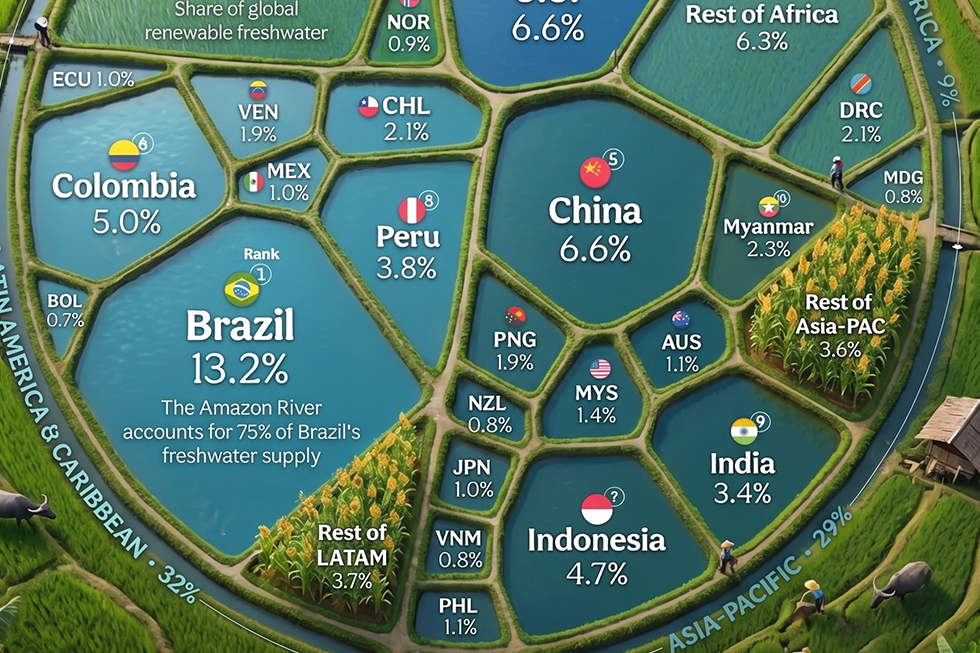
TARLAKENYO — The Philippines ranks 17th worldwide in renewable freshwater resources, placing it among the top nations for natural water wealth, according to data from FAO Aquastat and the World Bank.
Holding roughly 479 billion cubic meters of renewable internal freshwater — about 1.1 percent of the global total — the country sits ahead of neighbors such as Vietnam and Japan.
However, national environmental experts and agricultural planners note that high volume rankings on paper do not automatically guarantee seamless water security for local communities and farms.
Like top-ranked global leaders Brazil and Russia, the Philippines struggles with severe geographic and seasonal distribution bottlenecks. While the archipelago receives abundant rainfall overall, water resources are unevenly spread across regions and heavily impacted by dry spells, shifting climate patterns, and infrastructure limitations.
The agricultural sector bears the primary brunt of these challenges.
Farming accounts for approximately 70 to 80 percent of total freshwater withdrawals in the country, largely driven by water-intensive crops such as paddy rice. During extended dry seasons and El Niño cycles, irrigation systems managed by state agencies frequently face operational strain, creating tough competition between agricultural needs and municipal water supply in major urban centers.
On a global scale, freshwater remains heavily concentrated within a few large territories. The top five nations — Brazil (13.2%), Russia (10.1%), Canada (6.7%), the United States (6.6%), and China (6.6%) — control over 43 percent of the planet’s total renewable freshwater resources.
At the regional level, Latin America and the Caribbean lead with nearly one-third of the world’s freshwater, followed closely by the Asia-Pacific region at 29 percent.
Meanwhile, acute water scarcity persists across Africa (9%) and the Middle East (1%), which combined account for 14 of the world’s 20 most water-stressed countries per capita.
To bridge the gap between raw water volume and actual availability on the ground, Philippine agricultural authorities continue to promote modernized irrigation practices, including water-saving techniques like Alternate Wetting and Drying (AWD) for rice fields, solar-powered pump networks, and improved canal lining to prevent conveyance losses.
