

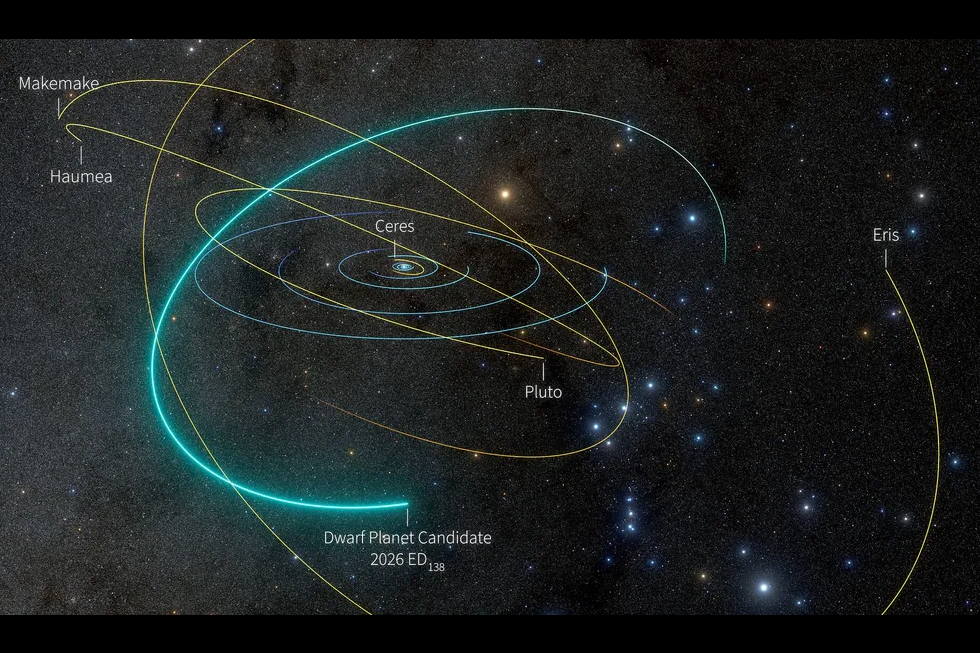
TARLAKENYO — Astronomers using the Vera C. Rubin Observatory have discovered a massive, bright object hidden in the distant Kuiper Belt beyond Neptune.
Designated 2026 ED138, this potential new world orbits the sun at roughly 46 times Earth’s distance and measures between 600 and 1,500 kilometers in diameter. If confirmed, this size would place it at more than half the diameter of Pluto, making it one of the largest objects ever found beyond Neptune and potentially raising the number of officially recognized dwarf planets to six after Pluto, Ceres, Eris, Haumea, and Makemake.
The discovery was made possible by the observatory’s cutting-edge capabilities, which cut through the intense stellar clutter of the inner Milky Way.
ED138 had previously eluded detection because its orbit is tilted at a 25-degree angle from the solar system plane, allowing it to hide behind galactic camouflage. Matthew Holman, an astrophysicist at the Smithsonian Astrophysical Observatory, developed the software algorithms alongside colleague Kevin Napier to parse through billions of observations, ultimately spotting the moving object in Rubin’s data.
Following the initial identification, the research team mapped out a 10-year orbit for ED138 by combining recent Rubin data with archival images from the Dark Energy Camera on the Victor M. Blanco 4-meter Telescope in Chile.
Because dwarf planets are dim and move slowly from Earth’s perspective, finding them requires exceptional technological precision. Future observations will determine the object’s precise density and confirm whether its gravity is sufficient to shape it into a sphere, sealing its status as a dwarf planet and kicking off what researchers expect to be a wave of new discoveries as the Rubin Observatory continues mapping the southern sky.
