

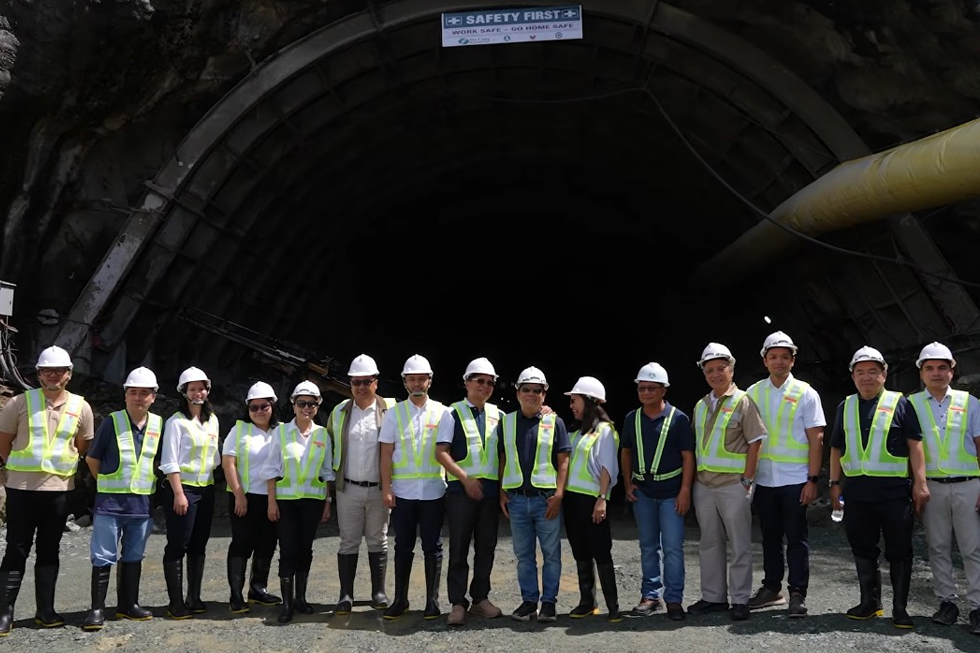
SAN JOSE, Tarlac — The long-awaited promise of abundant water and agricultural abundance is drawing closer for thousands of Tarlaqueño farmers as national and local leaders descended on Barangay Maamot to inspect the ongoing construction of the P20.544-billion Balog-Balog Multi-Purpose Project (BBMP) Phase II.
National Irrigation Administration (NIA) Administrator Eduardo Guillen led a high-level site inspection in this mountainous town, reiterating the national government’s commitment to fast-tracking the massive infrastructure development.
Joining him on the ground to champion the interests of local communities were Tarlac 2nd District Representative Maria Cristina Angeles and San Jose Mayor Romeo Capitulo.
During the inspection, Guillen emphasized that the administration is focused on delivering tangible results for the agricultural sector, moving past political divisions.
“The mindset of the President is not the color of politics, but what is most important is the benefits for the interest of the people,” Guillen said.
In late 2025, Senator Panfilo Lacson called on NIA to explain to taxpayers about the wastage of funds poured into into the 38-year-old project in Tarlac. The lawmaker cited the P7.006 billion funding the BBMP received from 2015 to 2020 alone.
The project was started in 1988 with Phase II starting in 2017 and slated for completion before the end of then-President Rodrigo Duterte’s term.
Now, four years into the presidency of Ferdinand Marcos Jr, the project is just 45.79 percent complete.
However, the NIA chief acknowledged that the engineering marvel being built in the heart of Tarlac is one of the most challenging undertakings in the history of the country’s irrigation development.
“Sa lahat ng project ng NIA, iyong Balog-Balog ang pinakamahirap,” Guillen admitted, pointing to the complex construction of two diversion tunnels and specialized structural features designed to withstand major seismic activities.
For Tarlac, the BBMP has been a generations-long dream. Its roots trace back to a World Bank-funded feasibility study conducted between 1978 and 1980. While the National Economic and Development Authority (NEDA) — now the Department of Economy, Planning, and Development — approved the project in 1988 with an initial cost of P2.712 billion, the catastrophic 1991 eruption of Mt. Pinatubo buried parts of the province in volcanic ash and disrupted foreign funding, forcing the government to split the project into two phases.
The completed Phase I, which ran from 1999 to 2012, has already brought life-changing water to 12,475 ha. of farmland, benefiting 7,340 local farmers through the rehabilitation of the Tarlac Diversion Dam and the upgrade of local conveyance canals.
Once fully operational, it will irrigate an additional 21,935 ha., bringing the total service area to 34,410 ha. and securing the livelihoods of over 21,700 farmers across Tarlac and neighboring fields in Central Luzon. Beyond irrigation, the mega-dam will feature a 43.5-megawatt hydropower facility and a 150-hectare inland fishery.
