
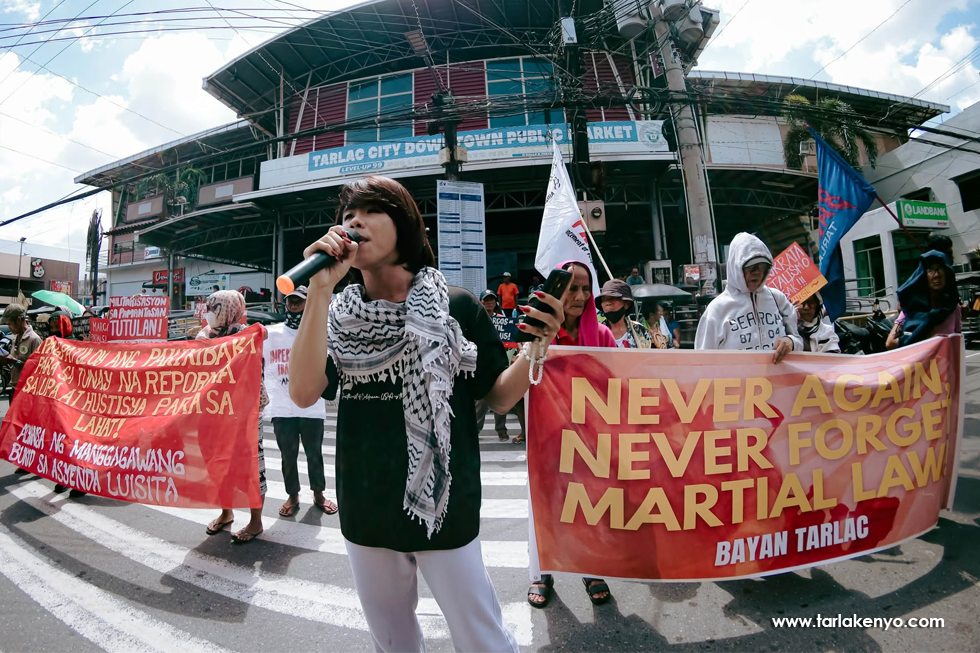
TARLAC CITY, Tarlac — Scores of protesters belonging to progressive groups marched from F. Tanedo Street to Macabulos Drive today to commemorate the 54th anniversary of the declaration of martial law by the late president Ferdinand Marcos Sr in 1972.
The Bayan Tarlac-led group carried banners that remind people of the atrocities committed by the police and the military under the Marcos Sr dictatorship.
The protesters were shadowed by military and police personnel throughout the march and short program. They dispersed peacefully afterwards.
Proclamation No. 1081, signed on September 21, 1972, plunged the Philippines into an era spanning from 1972 to 1986 that remains heavily documented for widespread human rights violations, arbitrary arrests, detentions, and strict censorship curbing freedom of expression and assembly.
Aside from looking back at historical atrocities, demonstrators raised urgent local and national issues, directing their calls against the proposed Pax Silica Project in New Clark City and the escalating militarization of rural communities affecting Indigenous Peoples and residents across Tarlac province.
The demonstration unfolded amid a recent digital controversy involving the local law enforcement agency.
Days prior to the anniversary, the Public Information Office of the Tarlac Police Provincial Office TPPO triggered a political firestorm on September 15, 2026, when its official Facebook page shared an anti-martial law graphic carrying the phrases “Never Forget” and “Always Remember”.
Several police officials, through intermediaries, have asked Tarlakenyo to delete the post, which shows the local police’s revisionist memory.
Observers quickly noted the profound irony of the post, which targeted the authoritarian regime established by the father of the sitting president, Ferdinand “Bongbong” Marcos Jr.
Analysts also pointed out the historical sting of the gaffe given that the Philippine Constabulary — the direct predecessor of the modern police force — acted as a primary enforcer of martial law.
For Tarlac, memories of those turbulent years cut deeply, particularly because the late opposition leader Benigno “Ninoy” Aquino Jr., a native son of Concepcion, Tarlac, served as the regime’s most prominent political prisoner prior to his assassination in 1983.
Although provincial command officials swiftly pulled down the graphic, the unintended blunder added digital fuel to a province already engaged in active commemoration and dissent.
