

TARLAC CITY, Tarlac — Localized class suspensions will no longer mean a total standstill, according to education authorities, as about 26 million enrollees for School Year 2026-2027 are due to start school on June 8, 2026.
The Department of Education (DepEd) has officially issued DepEd Order No. 014, s. 2026, establishing the “Guidelines on Learning Continuity in Emergencies”.
Signed by Education Secretary Sonny Angara, the new policy mandates a levels-based decision-making system that dictates exactly what happens to teaching and learning during typhoons, extreme heat, earthquakes, and human-induced crises.
The order seeks to cure the severe impacts of learning loss and disruption caused by the country’s vulnerability to natural disasters, climate change, and armed conflicts. Under the new policy, the automatic or localized cancellation of in-person classes, whether declared by a school head, a local chief executive, or other government agencies, will trigger specific, graduated operational protocols grouped into four distinct levels.
The Four Levels of Emergency Class Cancellations
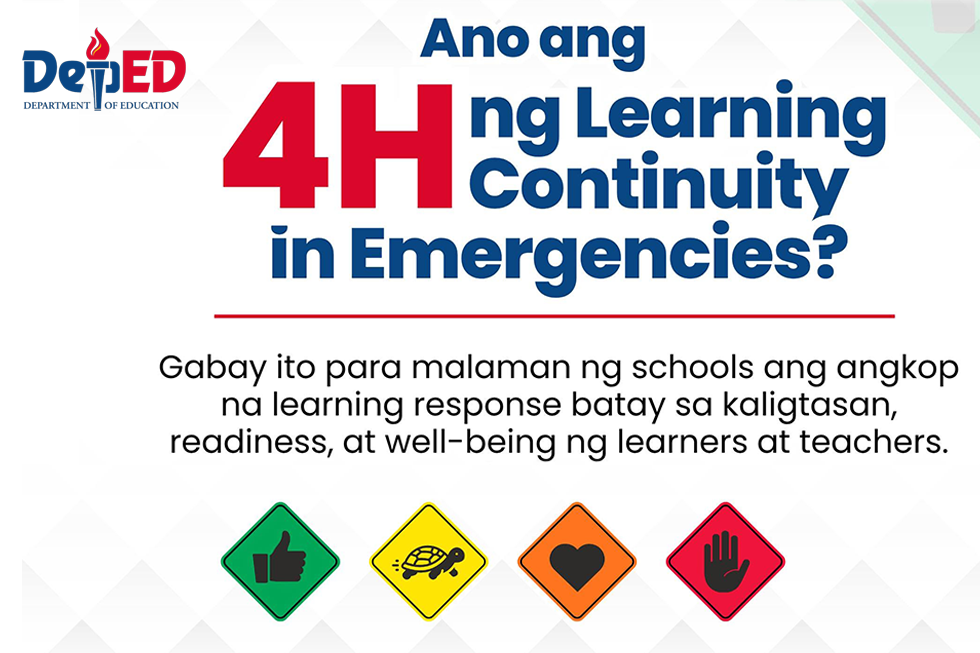
The heart of the new guidelines is a color-coded, four-level framework structured around the actual physical safety and emotional well-being of learners and teachers.
The first level, Hayo (Continue), represents the normal state where conditions are ideal, stakeholders are safe, and regular in-person classroom learning proceeds with full curriculum delivery and remedial programs.
When minor to moderate disruptions occur, and routines are broken, schools transition to Hinay (Ease-in). Under this level, regular classes are intentionally slowed down to reduce pressure on families and educators.
If disaster conditions worsen and communities suffer displacement or severe distress, the status shifts to Hinga (Check-in). At this stage, academic demands are heavily reduced. Instructional time shifts completely away from standard content progression to focus on the psychological and social-emotional well-being of the students.
The most severe status is Hinto (Stop), which halts all forms of academic learning entirely. This is reserved for extremely unsafe conditions where full attention must be given to protection, survival, emergency response, and securing the basic needs of the learners and personnel.
Massive Effects on Academic Demands and Pacing
The policy directly changes how cancellations affect the daily school grind. Under the Hinay (Ease-in) level, the number of subjects scheduled per day is strictly reduced, and the duration of learning activities is shortened. Furthermore, formative assessments are limited only to essential core competencies.
Once a school drops into the Hinga (Check-in) tier, any academic learning is restricted to reviewing past lessons. Formative assessments become completely optional and low-stakes, and teachers are barred from imposing heavy academic loads. Instead, teachers use “check-in guides” to monitor learner safety, with brief reflective prompts that carry zero academic weight.
Remedial and Continuity Measures Enforced
To combat learning loss without compromising safety, DepEd has laid out strict standards for remedial and distance learning experiences depending on the active emergency level.
For schools in the Hinay (Ease-in) phase, learning continuity is maintained through a combination of online synchronous classes, digital modules, broadcast materials (like DepEd TV), print modules, or short learning packets, while parents are provided with “Family Kits” to facilitate home-based studies.
In the Hinga (Check-in) phase, offline, low-demand resources are heavily prioritized to accommodate power outages and displacement. Schools are required to deploy standardized pre-positioned “Emergency Learning Kits” and “Edukahon” school recovery kits, which include low-demand learning tasks, worksheets, and simple reading materials designed for independent or minimally supervised use.
For the Hinto (Stop) level, school heads are directed to immediately activate crisis management protocols and coordinate relief initiatives with Local Government Units (LGUs). The primary remedial focus here is the mandatory provision of Mental Health and Psychosocial Support (MHPSS) and Psychological First Aid (PFA) to affected teachers and learners, handled by trained guidance personnel once the immediate danger passes.
Institutional Safeguards and Local Autonomy
The guidelines make it clear that school heads must exercise sound professional judgment when navigating these levels, integrating local community knowledge, such as indigenous understandings of environmental hazards. Crucially, the policy explicitly states that actions taken in good faith by school heads and teachers in compliance with these guidelines will not subject them to personal liability.
The policy also leaves the ultimate veto power to the home: parents and legal guardians retain the absolute responsibility to determine whether their children should attend classes based on physical and mental health risks during calamities, even if no official suspension order has been issued. However, parents are also burdened with the responsibility of ensuring their children catch up on missed competencies later on.
The DepEd Order takes effect immediately following its publication.
