
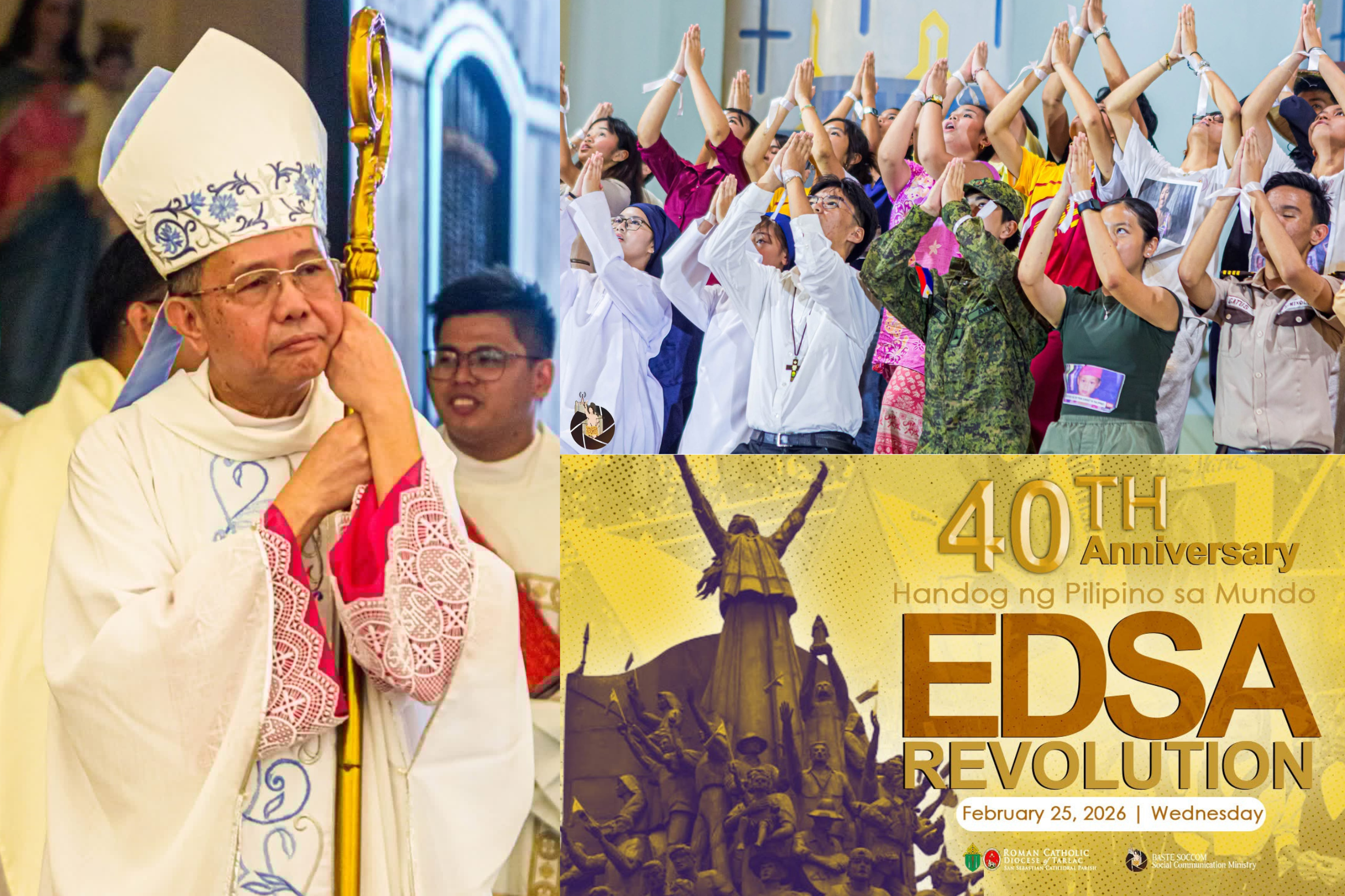
TARLAC CITY, Tarlac (March 1, 2026) — Forty years after millions of Filipinos took to the streets in a bloodless uprising that toppled a dictatorship, the Diocese of Tarlac gathered clergy, religious, students, and lay faithful at the San Sebastian Cathedral on February 25, 2026, for a solemn commemoration of the EDSA People Power Revolution.
Titled “Handog ng Pilipino sa Mundo: EDSA Revolution @ 40,” the event was initiated by Most. Rev. Roberto C. Mallari, D.D., Bishop of Tarlac, who invited the faithful especially the youth to remember not merely as a date on the calendar, but as a living legacy of faith, unity, and courage.
“Alalahanin ang mga kamangha-mangha na ginawa ng Panginoon,” Bishop Mallari said in his circular letter, drawing from Psalm 105:5, setting the tone for an afternoon that blended remembrance with a challenge for the present generation.
A Gathering Rooted in Faith and History
The program opened with a performance of the nationalist song “Bayan Ko” by students of Tarlac National High School, accompanied by choir, dance, guitars and ukulele. Seminarians from Our Lady of Peace College Seminary led the doxology, grounding the event in prayer.
Rev. Fr. Randy Salunga, Director of Caritas Tarlac, delivered opening remarks that jolted the audience into reflection.
“Let’s start with the truth. This gathering is a waste of time. Walang kwenta ito. Walang saysay. It has no value. It has no meaning,” Fr. Salunga began, drawing attention before pivoting to the heart of the matter.
“Standing here today doesn’t lower the price of rice. It doesn’t fix our transport system. Matindi pa rin ang traffic. And it doesn’t put money in the pockets of the millions of Filipino families struggling to survive the day.”
He challenged those present: “If you are here just to look back, you are wasting your breath. Sayang lang ang oras natin kung hanggang paggunita lang tayo. But if you are here to decide that the next 40 years will not be a repeat of the last, then and only then does EDSA finally mean something.”
“Let us stop commemorating a revolution and start living one. Huwag lang nating alalahanin ang EDSA. Pangatawanan natin ang EDSA.”
Voices from the Past, Lessons for the Present
An audio-visual presentation transported attendees back to 1986, showing footage of the four-day uprising where unarmed Filipinos armed with rosaries, flowers, and prayers, faced tanks and soldiers along EDSA.
Ms. Alejandria Gumafelix, a dedicated member of the August Twenty-One Movement (ATOM), shared her firsthand experience of the protests that led to the revolution. She recalled the “Tarlac to Tarmac March,” a nine-day protest walk from Ninoy Aquino’s birthplace in Concepcion, Tarlac, to the airport where he was assassinated in 1983.
“The freedom we regained must be valued, defended, and passed on to every new generation,” Gumafelix said. “Let us be vigilant against disinformation, which is very rampant today. There are vloggers paid to post false narratives on the West Philippine Sea to disunite us. Let us choose our leaders wisely.”
Sr. Concepcion Laquigan, SSPS, who has served for 51 years as a religious sister, offered a deeply personal account of standing in front of military tanks at the third gate of Camp Aguinaldo.
“Maghawakan tayo ng kamay. Kailangan malakas kang humawak sa katabi mo, dahil kung hindi, baka tatakbo, iiwanan ka,” she recalled of those tense moments. When a tank stopped inches from her, the driver told her, “Sister, hindi namin kayang patayin ang aming kababayan.”
Sr. Concepcion attributed the revolution’s success to Filipino character traits: pakikipagkapwa-tao, deep faith, resilience, joy and humor, creativity, and patriotism.
“These are our God-given characters that made EDSA successful. And it’s a pity if it will be lost and not taught to our children of today. Hanggat hindi tayo nagkakaisa, hanggat nagkanya-kanya tayo, walang mangyayari. Pabagsak tayo lahat.”
Tarlac’s Special Place in EDSA History
Tarlac City Mayor Susan Yap shared her personal story of growing up during martial law, when her father, Jose Yap, was incarcerated. She recalled being separated from her siblings for months as a child.
“As we mark the 40th anniversary, we do so not to dwell on the divisions of the past, but to honor the enduring spirit of our democracy, a spirit that has its roots deep in the soil of Tarlac,” Mayor Yap said.
“Tarlac has always been a province of courage. We cannot look at our history without remembering those who sacrificed their comfort, their safety, and in the most painful cases, their lives.”
Gov. Christian Yap’s message, read by Mr. Max Guillermo, echoed this sentiment: “Ang EDSA ay ipinapaalala ng sambayanang Pilipino na ang kapangyarihan ng pagkakaisa, pananalig sa Diyos, at mapayapang pagkilos ay higit na makapangyarihan kaysa anumang pwersa ng dahas o pananakot.”
A Call for Accountability and Continuing the Fight
Ms. Teresita Quintos Deles, the first woman presidential advisor on the peace process, delivered a stirring talk on the unfinished business of EDSA. She shared her experiences under martial law, including the arrest of her then-boyfriend (later husband) and the daily terror of living under dictatorship.
“People power happened because there was martial law,” Deles emphasized. “Importante pong maalala at mapaniwala na hindi po ganun. That it was a terrible time that killed so many of our dreams. And in fact, killed so many of our people.”
She pointed to the lingering wounds of dictatorship that were never fully addressed the lack of a truth commission, official sites of memory, or accountability for human rights violations.
“Among the post-authoritarian states today, the Philippines stands unrivaled in the example of extreme impunity,” Deles said. “Kung walang accountability, uulit, uulit, uulit.”
She urged concrete actions: prosecute plunderers, pass the anti-dynasty law, establish an independent commission on government funds, and create a truth commission on extrajudicial killings under the war on drugs.
“Tayo ang people power. Ang tanong, ano ang people power mo?” Deles challenged, adding that while her generation may only glimpse the “Promised Land,” the future belongs to the youth. “Please take it and make of our country a nation that our people deserve. That all our children and our children’s children deserve.”
Unity in Prayer and Commitment
The program featured performances from Tarlac Montessori School, San Sebastian Cathedral School, College of the Holy Spirit of Tarlac, and the Tarlac State University Chorale, singing EDSA anthems like “Magkaisa” and “Isang Lahi.”
The commemoration culminated in a Holy Mass presided by Bishop Mallari, with the clergy of the diocese concelebrating.
In his homily, Bishop Mallari reflected: “Sa panonood ko kanina, I understood madaming mga mitsa para pumutok ang rebolusyon ng EDSA. Naiintindihan ko rin na yung mga pumunta ng EDSA ay iba-iba rin ang dahilan pero nagkakaisa sa kanilang pagmamahal sa Diyos at pagmamahal sa bayan.”
He addressed the youth directly: “Sa panahon ngayon ng social media, mabilis ang pagkalat ng impormasyon, ngunit mabilis din ang pagkalat ng maling impormasyon. Bilang kabataan, tayo ang nasa gitna ng digital na mundo. Ang pag-alala sa EDSA ay hindi lamang pagdalo sa paggunita. Ito ay pagiging mapanuri, responsable at may paninindigan sa katotohanan.”
“Ang tunay na diwa ng EDSA ay nabubuhay sa bawat kabataang tumatanggi sa kasinungalingan, sa korapsyon, sa kultura ng panlilinlang.”
He concluded with a prayerful charge: “Ang EDSA ay paalala na ang lakas ng bayan ay nasa pagkakaisa. Paalala nga sa atin—tayo ang People Power. Dagdag ko, tayo kasama ang Diyos—ito ang mas matinding People Power.”
“Sa isang mundong madaling maghati-hati dahil sa pulitika, opinyon o ideolohiya, tinatawag ang kabataan, tayong lahat upang maging tulay at hindi pader.”
Fr. Lito Santos closed the program with words of gratitude to all performers, speakers, and attendees, reaffirming the challenge set forth at the opening: that this gathering would not end when the doors closed, but ignite a living revolution of faith, truth, and service.
As the sun set over San Sebastian Cathedral, one truth stood unmistakably clear: the spirit of EDSA is not meant to be a relic of the past, but a living inheritance one that must never be forgotten, especially by the young, for in their hands lies the task of carrying its flame forward, today, tomorrow, and for generations yet to come.
